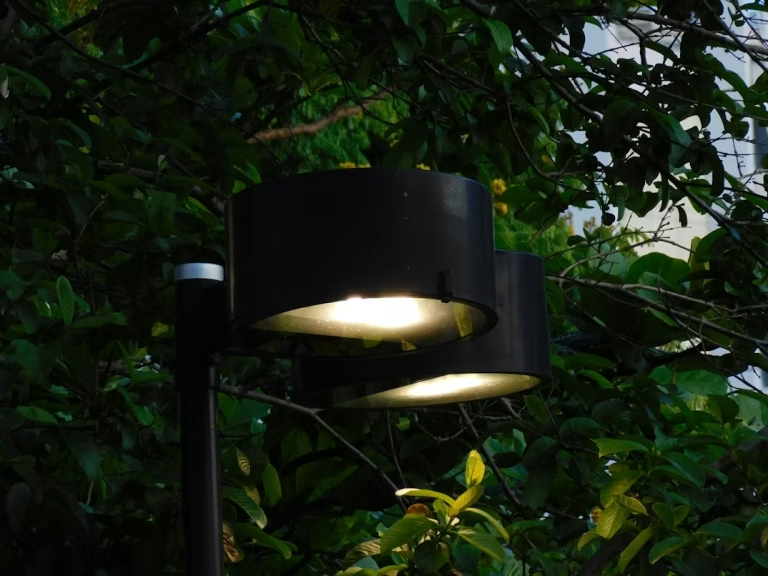
Car parks are one of the most common locations for security incidents in Perth and across Western Australia. They combine predictable risk factors: low natural surveillance, mixed pedestrian and vehicle movement, variable lighting, and after-hours isolation. Even well-managed sites can develop blind spots over time as landscaping grows, tenant patterns change, or CCTV and lighting performance drifts.
If you are looking for a car park security review in Perth, you are usually trying to answer a few practical questions:
- why are incidents occurring here?
- where are the control gaps?
- what should we fix first to reduce risk?
- how do we improve safety without wasting money or over-specifying upgrades?
A car park security review gives you a clear, vendor-neutral assessment of current conditions and a prioritised plan to uplift safety and security outcomes.
Smartsec Security Solutions conducts car park security reviews across Western Australia, providing practical recommendations that are straightforward to implement and defensible to stakeholders.
What a car park security review is
A car park security review is a structured assessment of how your car park performs from a safety and security perspective, with a focus on real-world risk points.
It considers the full picture:
- the physical environment and layout (including sightlines and concealment)
- lighting performance and after-hours visibility
- pedestrian routes and conflict points
- CCTV coverage and image outcomes
- access control where applicable (gates, intercoms, staff-only zones)
- signage, wayfinding, and how people actually move through the space
- operational processes (reporting, response, patrol patterns, maintenance)
The aim is not to create unnecessary complexity. The aim is to identify what is driving risk and provide a staged plan to address it.
When you should commission a car park security review
A car park security review is typically worthwhile when you have any of the following:
- recurring theft, damage, break-ins or antisocial behaviour
- customers, tenants or staff reporting fear points or near misses
- poor lighting outcomes or obvious dark pockets at night
- CCTV footage that is not usable when incidents occur
- unclear pedestrian paths that force people to walk through vehicle lanes
- stairwells, lift lobbies or corridors that feel unsafe or attract loitering
- after-hours access issues or unauthorised entry
- a planned upgrade and you want independent guidance before engaging vendors
It is also valuable as a preventative step before a refurbishment, tenancy change, or asset refresh, because car park risks are often easier and cheaper to reduce before problems become entrenched.
Why car parks develop predictable security hotspots
Car parks are not inherently unsafe. They simply contain predictable risk patterns that repeat across many sites.
Common contributors include:
- long sightlines broken by columns, ramps, planter beds or solid walls
- concealed edges near stairwells, lift lobbies, toilets, or rear access points
- inconsistent lighting and glare that reduces visibility
- areas with low legitimate activity, especially after hours
- pedestrian desire lines that cut across bays and create conflict points
- landscaping that grows into sightlines over time
- CCTV placed for coverage quantity rather than outcomes
A good review focuses on these patterns and ties them to your site layout, operating hours, and user behaviour.
Lighting is usually the fastest security uplift
In many Perth sites, lighting is the single biggest driver of both real safety outcomes and perceived safety in car parks. Patchy lighting creates shadow pockets, glare and harsh contrast that reduce natural surveillance and can make CCTV less effective.
A car park security review will identify:
- dark pockets on pedestrian approaches and near lift/stair transitions
- glare points and harsh contrast under awnings or near reflective surfaces
- areas where lighting coverage prioritises vehicle circulation but neglects people
- vegetation or structures that create long-term shadow problems
If lighting is a major driver at your site, a dedicated lighting audit can provide deeper technical assessment and a clear upgrade pathway, especially where you need to justify improvements and ensure visibility is being achieved in the right places.
CPTED: why the design of the car park matters
Car park incidents often cluster in the same places: transition zones, corners, rear edges, and routes where people feel isolated. This is why CPTED (Crime Prevention Through Environmental Design) is a core lens within a strong car park review.
A CPTED-driven review looks at:
- sightlines and natural surveillance along key routes
- concealment created by landscaping, walls, columns and recesses
- clear territorial cues and boundary definition between public and private areas
- activation and legitimate use, especially after hours
- design changes that improve safety without changing the look and feel of the site
If the car park is part of a broader precinct, development, or public realm environment, a more formal CPTED assessment can be a strong next step to ensure the design and upgrades reduce risk over the long term.
CCTV outcomes and common blind spots
Car parks often have CCTV, yet incidents still occur because cameras are not delivering the outcomes people assume they are delivering.
A car park security review considers:
- are cameras positioned to capture faces and actions at key decision points?
- is image quality usable under real lighting conditions at night?
- are there blind spots in stairwell approaches, lift lobbies, or along boundary edges?
- are there cameras covering transition routes rather than only vehicle lanes?
- is there a clear process for footage retrieval, export, and preservation?
The aim is to ensure the CCTV system supports operational outcomes, not just recording.
Pedestrian routes, desire lines, and conflict points
One of the most common car park risks is not theft. It is people being forced into unsafe movement patterns.
A car park security review examines:
- where people naturally walk versus where you intended them to walk
- whether routes are legible, direct, and feel safe
- crossings and pinch points where vehicles and pedestrians compete
- whether the route to lifts, stairs, and entries is obvious and protected
- whether wayfinding and line marking are doing their job
Improving pedestrian routing often reduces both safety risk and behaviour-based incidents because people are less likely to end up in isolated areas.
Landscaping and concealment
Landscaping can improve amenity, but it can also create hiding opportunities and reduce natural surveillance.
A review checks:
- shrubs and trees that block sightlines into bays and along pathways
- concealment near stairwells, boundary fences, and entry points
- planter walls or screening that creates blind corners
- maintenance realities and how quickly vegetation growth can degrade visibility
In many cases, simple trimming, species selection, or repositioning can improve visibility while preserving aesthetics.
Access control and after-hours management
Some car parks include access control, gates, or restricted zones. Even where no gates exist, after-hours behaviour needs to be considered.
A review considers:
- after-hours access pathways and whether they are controlled or monitored
- whether doors from car parks to buildings are being propped or bypassed
- whether alarms are in place and what happens when they activate
- whether monitoring response time is tested and reliable
- whether there is a clear escalation pathway if calls are missed
This is often where operational improvements create immediate uplift without capital spend.
When a broader security risk assessment is the better option
Sometimes a car park review identifies that the issues are part of a wider risk picture across a site or portfolio. For example, the car park may be only one of several high-risk zones, or incidents are linked to broader governance and response issues.
In these cases, a formal security risk assessment may be the right next step, particularly if you need:
- a risk register and prioritised treatments across multiple areas
- defensible risk ratings (likelihood, consequence, residual risk)
- a structured treatment plan for governance and approvals
- a clear basis for longer-term investment decisions
A car park review can either stand alone or form the car park chapter within a wider risk assessment.
What you receive at the end of a car park security review
A car park security review should give you a clear and usable plan, not a vague list of issues.
Typical deliverables include:
- summary of key findings and what is driving risk
- priority actions grouped into short, medium and longer-term improvements
- quick wins that can be implemented with minimal disruption
- funded upgrade recommendations where they are justified
- vendor-neutral guidance to support briefing and fair quoting
- a defensible rationale to support internal approvals
Next step: a confidential conversation
If you need a car park security review in Perth, Smartsec Security Solutions can help you identify what is driving risk, prioritise practical improvements, and strengthen after-hours safety with clear, defensible recommendations.
For a confidential conversation, please contact us via our Contact page.